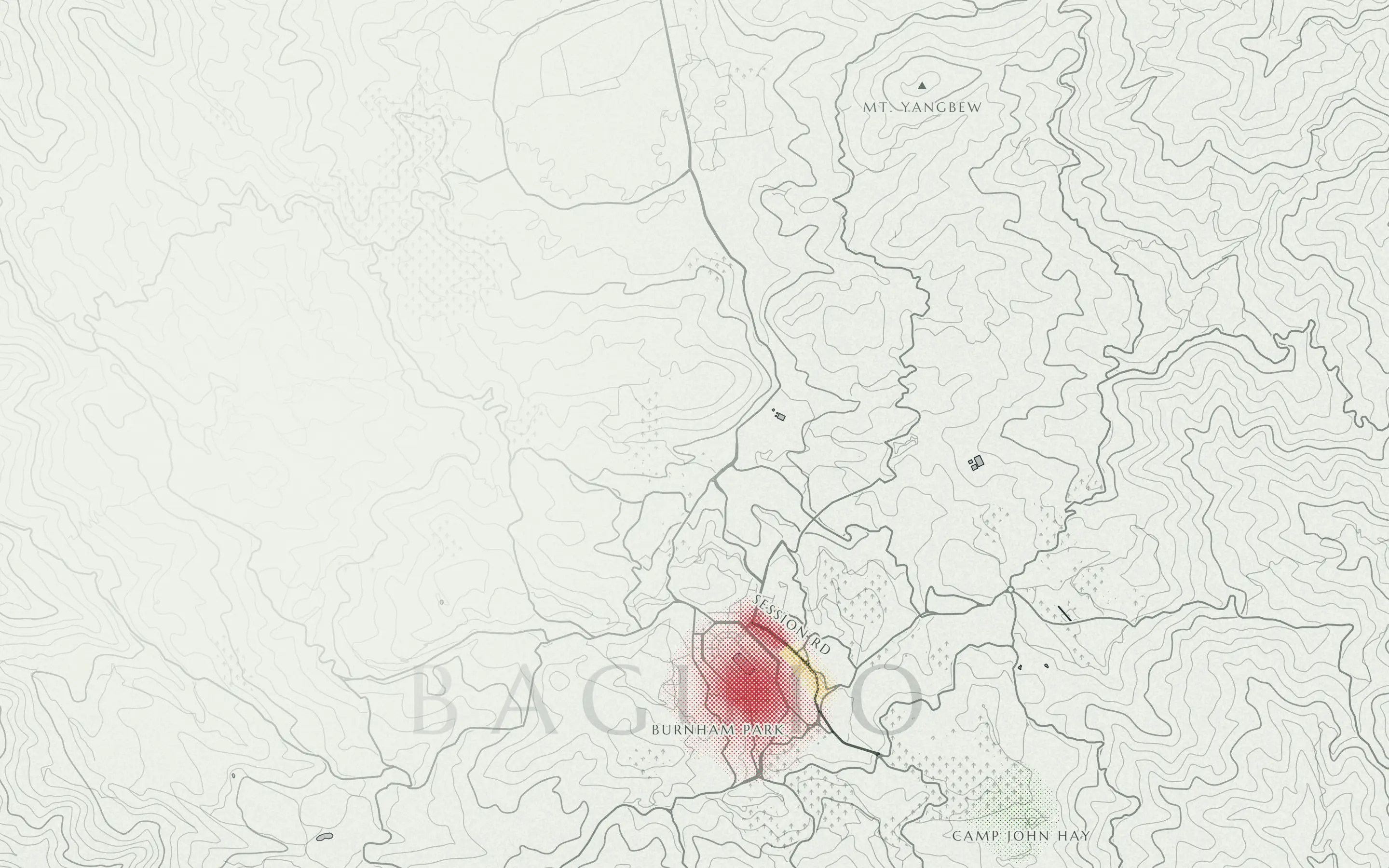
Trace the green.
NAVICA is Team Gabay’s real-time navigation and eco-tourism app for Baguio City. It shows where the crowds are and points visitors to lesser-known spots, with rewards for every visit.
Baguio is carrying more than it was built for.
- 1.56M
- tourists recorded in Baguio City in 2024.Baguio Chronicle (2025)
- 79%
- of Cordillera tourism is concentrated in Baguio.Baguio Chronicle (2025)
- 366K
- population, past a carrying capacity of 243K.Philippine Information Agency (2022)
- 58K
- vehicle entries, on roads designed for only 15K to 20K.Baguio Herald Express (2025)
Pitch deck, slide 2.
How far over?
366K against 243K: about 1.5 times capacity.
58K against 15K to 20K: about 2.9 to 3.9 times.
Ratios calculated from the figures above.
“How might we empower tourists, residents, and students to explore Baguio efficiently and sustainably?”


How Navica works
Navica puts four things in one app, so a visitor can see the crowd and choose somewhere quieter.
Four things in one app
- Smart map navigation
- Real-time crowd tracking
- Crowd rerouting
- AI chatbot
Users can explore lesser-known attractions around Baguio and collect rewards for every visit.
Pitch deck, slide 5.
The app’s own screens
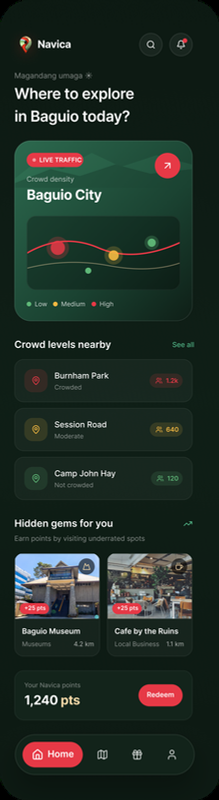
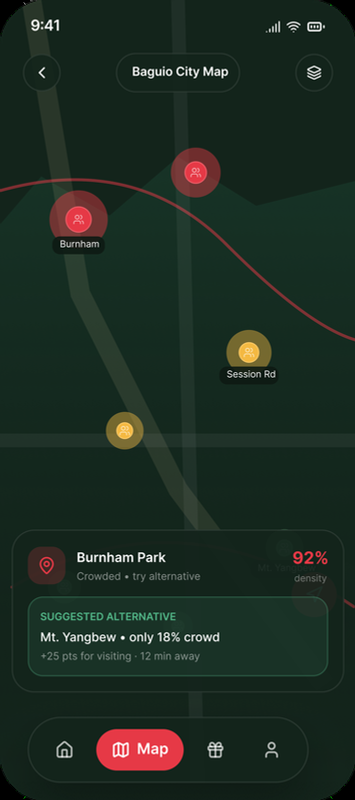
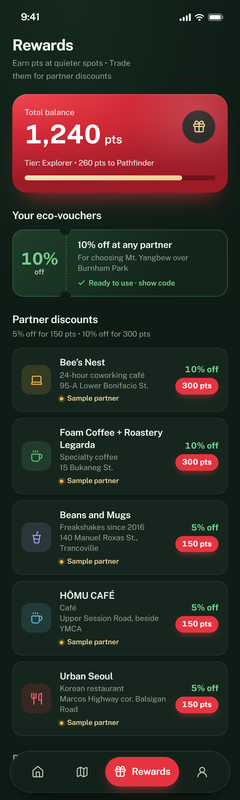
The screen scrolls. Drag it, use the wheel, or focus it and use the arrow keys.
- Home
- Live traffic: crowd density for Baguio City, from low to high.
- Crowd levels nearby: Burnham Park crowded (1.2k), Session Road moderate (640), Camp John Hay not crowded (120).
- Map
- Burnham Park at 92% density, with a prompt to try an alternative.
- The suggested alternative: Mt. Yangbew, only 18% crowd, 12 minutes away, +25 points for visiting.
- Rewards
- A points balance of 1,240, Explorer tier, 260 points to Pathfinder.
- Points trade for 5% off (150 points) or 10% off (300 points) at partner businesses, and choosing a quieter spot earns a 10% eco-voucher. The five partners shown are samples.
- Profile
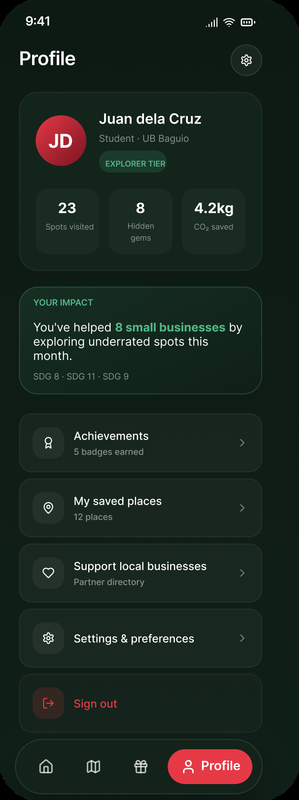
- 23 spots visited, 8 hidden gems, 4.2 kg of CO2 saved.
- Your impact: 8 small businesses helped this month, linked to SDGs 8, 9 and 11.
Screens from the pitch deck (slide 6); Rewards shows the new partner discounts, from the prototype app. Names and figures are sample data.
Contours: Baguio, 40 m

How the system works
Navica’s crowd levels come from a small sensor at each spot. It counts the phones around it, and only the count ever leaves the box.
Proposed for the pilot. No sensor is installed yet, every number in this section is an example, and the cost and range are estimates to confirm on site.
-
Phones announce themselves
A phone gives off two signals on its own. With Wi-Fi on, it keeps asking “is my network here?” With Bluetooth on, phones, earbuds and watches announce themselves to anything nearby.
The sensor listens for these and nothing else. It never picks up mobile data (4G or 5G): that needs a licence from the NTC, and it would invade privacy.
On parade day the same signals come from many more phones, packed along the route.
Burnham Park from OpenStreetMap. The phones are a drawing.
Burnham Park Session Rd Wi-Fi: “Is my network here?” Bluetooth: “I’m here”A phone Wi-Fi call Bluetooth announcement 100 m -
A sensor at the spot counts them
One small sensor covers one zone: an ESP32 board in a sealed, weatherproof box, about ₱1,000 per spot with its power and connection. It hears phones roughly 30 to 100 metres away.
Each phone’s address is scrambled with a code that changes every day, used only to count that phone once, then deleted. Nothing personal is kept, in line with the Data Privacy Act (RA 10173).
For the pilot, Burnham Park gets three: at the lake, the playground and the grandstand.
On parade day extra sensors on power banks are clipped along the parade route for the day, then collected.
Cost and range are estimates, to be confirmed by testing on site.
100 m 30 m LakeThe sensor, in its box
Sealed lid ESP32 board Sealed box Power lead- A phone’s address
- 3C:22:FB:9A:41:07
- Scrambled with today’s code
- f3a9 1c7e 08b2
- Counted once, then
- deleted
- Phones heard, 2:41 pm
- 411412
Example
-
One number a minute
Every minute the sensor sends a single number, how many phones it heard, over Wi-Fi to the Navica server. It needs the internet only to send, not to count.
A partner business at the spot can lend its Wi-Fi and a power outlet.
On parade day the portable sensors send theirs the same way, so the surge shows up minute by minute.
The readings shown are examples.
The sensor at the lake
Over Wi-Fi, once a minute
Navica serverBurnham Park, lake zone
- 2:39 pm405
- 2:40 pm409
- 2:41 pm412
412
phones heard at the lake at 2:41 pm, sent as one number
- 3712:32
- 378
- 3802:34
- 386
- 3912:36
- 398
- 4012:38
- 405
- 4092:40
- 4122:41 pm
-
The server compares it with normal
Phones aren’t people: some visitors carry none, and some carry a phone and a watch. A real headcount gives the correction. Bell Church has one gate and tickets, so volunteers can count the people inside while the sensor listens.
The server then checks the result against that spot’s usual for the day and hour, and shows Low, Medium or High: busier than normal for this spot.
On parade day packed bodies block the signal, so an event factor is measured at the first event, with volunteers counting the crowd by area.
400, 1,000 and 2.5 are example figures. The real factor comes from the Bell Church count.
Turning phones into people
412phones heard×2.5people per phone, from a headcount≈1,030people at the lakePhonesheard along the route×?the event factor, measured at the first event=Peoplein the crowdWhere the 2.5 comes from: a headcount at Bell ChurchFor comparison, the normal-day factor: a headcount at Bell Church
The sensor hears 400 phones
Volunteers count 1,000 people
Each dot is 10. 1,000 ÷ 400 = 2.5.
Against this spot’s normal for a Saturday at 2 pm
Against this spot’s normal, on parade day
High: busier than usual for this spotHigh: far above this spot’s normal
-
The app sends people somewhere quieter
Visitors see it in the app. Burnham Park shows as crowded, at 92%, with a quieter suggestion: Mt. Yangbew, at 18% and 12 minutes away.
Going where it suggests earns 25 points and a 10% eco-voucher to use at partner businesses.
On parade day the event is on the city’s schedule, so the app starts suggesting quieter spots, like Mt. Yangbew or the Camp John Hay trails, before the crowd forms.
The app’s own example screen (pitch deck, slide 6). The eco-voucher is from the team’s prototype app.
Burnham Park
92%
Crowded. Try an alternative.
Mt. Yangbew
18%
Only 18% crowd, 12 min away
Panagbenga parade day
On the city’s schedule
Suggestions start before the crowd forms.
Mt. Yangbew
or the Camp John Hay trails
+25 pts for visitingand a 10% eco-voucher at partner businesses
-
The city sees the shift
The city gets the same counts on a dashboard: crowd levels by spot and hour, and where visitors went instead.
They become a crowd report for sponsors every month, and a before-and-after report at the end of the pilot.
On parade day the first Panagbenga it logs lets Navica warn people ahead of the parade the next year.
A mock-up: the dashboard isn’t built yet, and the levels shown are samples.
City dashboardMock-up, sample levels
8 am1012 nn2 pm46 pm Burnham Park Session Road Camp John Hay Mt. YangbewLowMediumHighWhere the app sent visitors: Burnham Park to Mt. Yangbew
Crowd report for sponsors, every month
- Crowding at the busiest spot, at its peak hour
- Visits to the quieter spots
- Customers sent to partner shops
and a before-and-after report at the end of the pilot
The same spot, two days
Contours: Baguio, 40 m

A message of support from the City of Baguio
…innovations like Navica can help us manage tourism more responsibly while preserving the character, charm, and community life that make our city truly special.
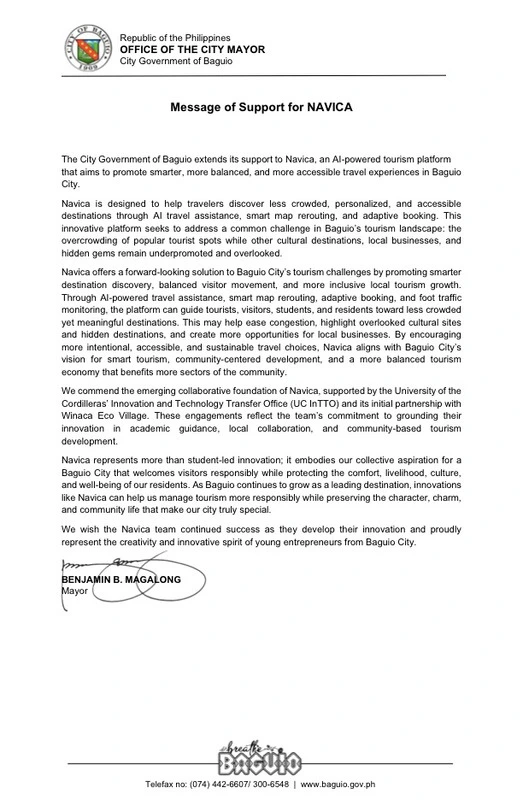
- The City Government of Baguio extends its support to Navica, an AI-powered tourism platform that aims to promote smarter, more balanced, and more accessible travel experiences in Baguio City.
- Navica is designed to help travelers discover less crowded, personalized, and accessible destinations through AI travel assistance, smart map rerouting, and adaptive booking. This innovative platform seeks to address a common challenge in Baguio’s tourism landscape: the overcrowding of popular tourist spots while other cultural destinations, local businesses, and hidden gems remain underpromoted and overlooked.
- Navica offers a forward-looking solution to Baguio City’s tourism challenges by promoting smarter destination discovery, balanced visitor movement, and more inclusive local tourism growth. Through AI-powered travel assistance, smart map rerouting, adaptive booking, and foot traffic monitoring, the platform can guide tourists, visitors, students, and residents toward less crowded yet meaningful destinations. This may help ease congestion, highlight overlooked cultural sites and hidden destinations, and create more opportunities for local businesses. By encouraging more intentional, accessible, and sustainable travel choices, Navica aligns with Baguio City’s vision for smart tourism, community-centered development, and a more balanced tourism economy that benefits more sectors of the community.
- We commend the emerging collaborative foundation of Navica, supported by the University of the Cordilleras’ Innovation and Technology Transfer Office (UC InTTO) and its initial partnership with Winaca Eco Village. These engagements reflect the team’s commitment to grounding their innovation in academic guidance, local collaboration, and community-based tourism development.
- Navica represents more than student-led innovation; it embodies our collective aspiration for a Baguio City that welcomes visitors responsibly while protecting the comfort, livelihood, culture, and well-being of our residents. As Baguio continues to grow as a leading destination, innovations like Navica can help us manage tourism more responsibly while preserving the character, charm, and community life that make our city truly special.
- We wish the Navica team continued success as they develop their innovation and proudly represent the creativity and innovative spirit of young entrepreneurs from Baguio City.
Contours: Baguio, 40 m

What Navica sets out to change, in the City’s own words.
Social
Environmental
Where the City’s message says the same thing
- Support Local Businesses: “create more opportunities for local businesses” (paragraph 3)
- Better User Experience: “smarter, more balanced, and more accessible travel experiences in Baguio City” (paragraph 1)
- Smarter City Planning: “aligns with Baguio City’s vision for smart tourism, community-centered development, and a more balanced tourism economy” (paragraph 3)
- Better Quality of Life: “protecting the comfort, livelihood, culture, and well-being of our residents” (paragraph 5)
- Reduce Congestion: “This may help ease congestion” (paragraph 3)
- Lower Transport Emissions: The City’s message doesn’t speak to emissions. The app’s sample profile shows 4.2 kg of CO2 saved (pitch deck, slide 6).
- Sustainable Tourism: “encouraging more intentional, accessible, and sustainable travel choices” (paragraph 3)
- Balanced Utilization: “balanced visitor movement” and “highlight overlooked cultural sites and hidden destinations” (paragraph 3)
Linked goals SDG 8 Decent Work and Economic Growth, SDG 9 Industry, Innovation and Infrastructure, SDG 11 Sustainable Cities and Communities.
The eight impacts: pitch deck, slide 10. The line matched to each is the team’s own reading of the City’s message.
Contours: Baguio, 40 m
411 people answered Navica’s feasibility survey.
Four findings
407
of 411 recognize Navica as a solution to overcrowding and tourism mobility in Baguio City.
Navica Feasibility Study Survey, run by the team. Pitch deck, slide 12.
- 407 of 411 recognize Navica as a solution to overcrowding and tourism mobility in Baguio City.
- 98% experience overcrowding while traveling around Baguio City.
- 86.62% are willing to purchase premium features.
- 9 business owners are interested in partnering with Navica (Navica Market Validation Survey).
Contours: Baguio, 40 m
How Navica earns
A free tier for everyone, and paid extras for visitors and for businesses.
Who pays for extras?
₱49
for 3 days of premium, or ₱99 for 7 days.
Pitch deck, slide 8.
| Feature | Free | Premium₱49 for 3 days or ₱99 for 7 days |
|---|---|---|
| Baguio City map | Included | Not listed |
| Local businesses | Included | Not listed |
| Real-time crowd monitoring | Not listed | Included |
| Dynamic crowd rerouting | Not listed | Included |
| AI chatbot | Not listed | Included |
| Rewards | Not listed | Included |
| Feature | Free | Premium₱499 a month |
|---|---|---|
| Basic business listing | Included | Not listed |
| Visibility on the Navica map | Included | Not listed |
| Priority placement on the map | Not listed | Included |
| Verified partnership badge | Not listed | Included |
| Custom profile branding | Not listed | Included |
A tick marks a feature the deck lists under that tier. Pitch deck, slide 8.
Contours: Baguio, 40 m
Who it’s for, and room to grow
Built for tourists, students and residents.
How big is it?
6.4M
potential tourists in the Philippines each year.
Turismo Central Luzon (2022). Pitch deck, slide 7.
- 6.4M potential tourists in the Philippines each year. Turismo Central Luzon (2022).
- 1.56M visitors to Baguio City a year. Baguio Chronicle (2025), as cited on slide 2.
- 31K projected pilot users within 12 months in Baguio City. A team projection, about 2% of Baguio’s 1.56M visitors (calculated).
| Feature | Navica | Baguio VISITA | Travel Philippines |
|---|---|---|---|
| Local business listings | Yes | Yes | Yes |
| Smart map crowd navigation | Yes | No | No |
| Real-time foot traffic tracking | Yes | No | No |
| Dynamic crowd rerouting | Yes | No | No |
Contours: Baguio, 40 m
From prototype to the Cordillera
Four steps, in order
Step 1 of 4
Prototype Development
Developing Navica’s AI concierge, smart mapping, and core platform features.
Pitch deck, slide 11. The deck gives the steps no dates.
- Prototype Development. Developing Navica’s AI concierge, smart mapping, and core platform features.
- Pilot Testing in Baguio City. Testing the application with local businesses and tourists in Baguio City.
- Local Business Expansion. Expanding partnerships with restaurants, transients, and tourism establishments.
- Smart Tourism Scaling. Scaling Navica across the Cordillera through LGU partnerships and tourism analytics integration.
Team Gabay
-

Cassandra Estrada
Hipster
Designs intuitive experiences for smarter tourism.
-

Catherine Navarro
Hustler
Drives partnerships and market growth.
-

Kristel Ruiz
Hacker
Builds AI-powered smart tourism solutions.
-

Gabriel De Guzman
Adviser
Students at the University of the Cordilleras, supported by UC InTTO.
Pitch deck, slide 14.
Milestones

July2026
Feasibility Study
Baguio City
Pitch deck, slide 14. Event, place and month as the deck gives them.

Liwliwa ya Sursuro 2.0. Baguio City, September 2025. 
Cohort 9. Baguio City, March 2026. 
National DisruptorX Pitching Competition. Cagayan de Oro, May 2026. Feasibility Study. Baguio City, July 2026.
Contours: Baguio, 40 m
Discover the heart of Baguio beyond the crowds.
Trace the green and see what’s never been seen.